
85% of Creditor Statements Processed Without Human Touch: How Moulton Law Group Automated Their Mail Room

Case Overview
If you've ever worked in a debt settlement or consumer credit operation, you know what a mail room looks like. Clients upload statements, collection notices, and settlement offers to a portal. Staff opens each one, figures out which client it belongs to, identifies the creditor account inside the CRM, reads the document for current balance, account number, minimum due, due date, and creditor changes, then updates the right fields in Debt Manager, uploads the file to the right attachment folder with the right naming convention, and creates the right follow up task if anything looks off. Multiply that by hundreds of documents per week, and you have a full team doing pure data entry that the business has no choice but to keep funded.
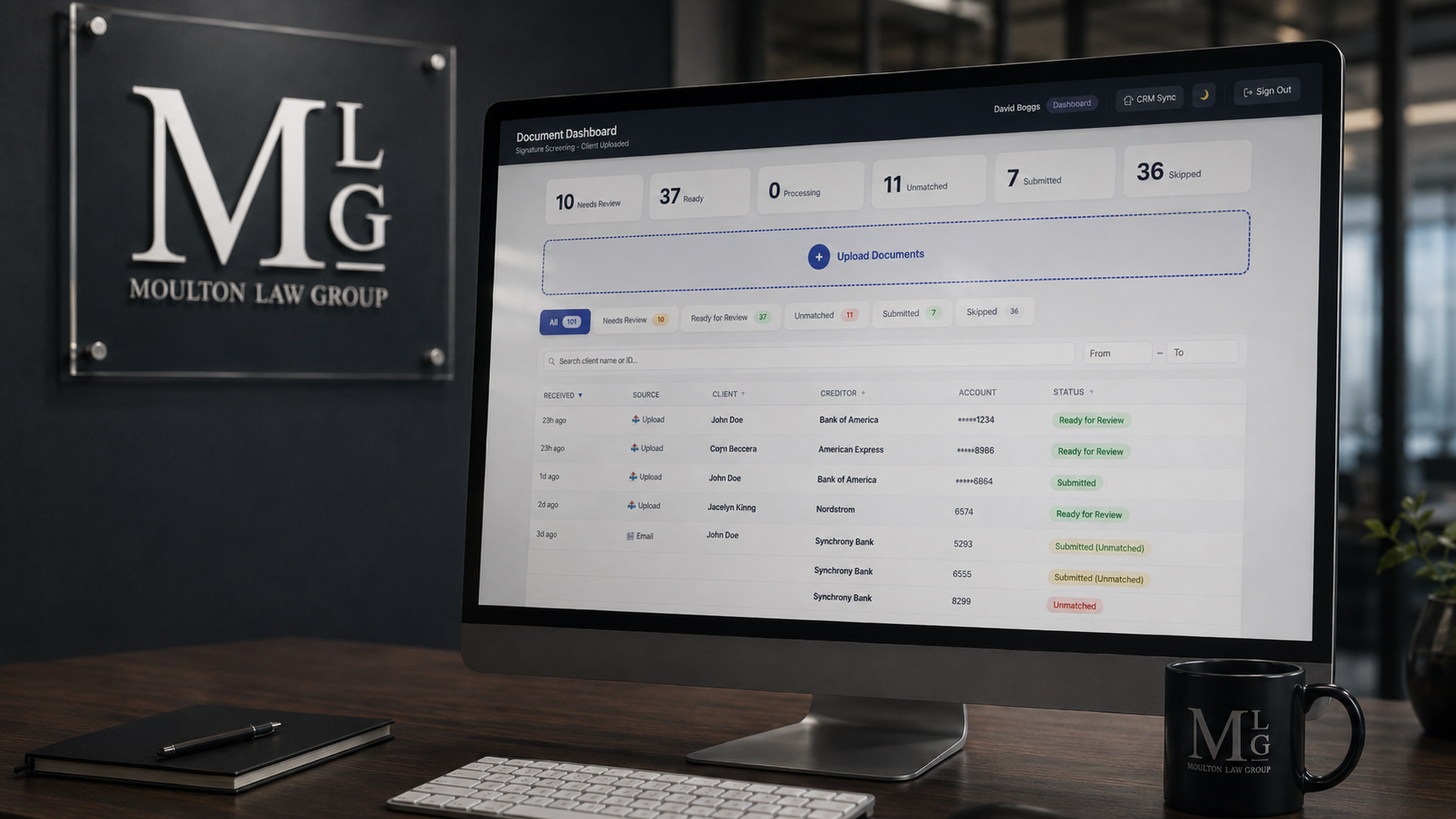
Moulton Law Group asked us to take that work off their team. We designed and built an end to end AI document pipeline that ingests uploads from three independent channels, classifies every page, identifies the client and the specific creditor account, extracts the structured fields, cross checks them against the existing Debt Manager record, applies the firm's exact field rules (what gets updated, what never gets touched, what only gets filled in if blank), and writes everything back to the CRM with the file attached and notes added.
When the AI is confident, the work flows through end to end without staff touching it. When confidence drops, the document lands in a lightweight verification queue with the extracted data prefilled, so staff verifies in seconds instead of doing the work from scratch. Across live processing, 85% of cases flow through end to end without staff involvement. 97.8% of AI extractions are accepted by staff with zero field edits. The pipeline pushes documents to Debt Manager at a 96.9% CRM operation success rate, and only 1 in every 14 documents needs any staff correction at all. The team that used to spend their week on data entry now spends it on the 15% of edge cases that actually require judgment, and the system is built to absorb the hundreds of daily documents that real production volume will bring.
Company Background
Moulton Law Group is a US debt settlement and consumer credit firm that processes high volumes of creditor correspondence on behalf of enrolled clients. Every day, statements, collection notices, settlement offers, and other creditor documents arrive through client portal uploads, internal staff scans, and forwarded email. Each one has to be matched to the right client, the right creditor account, and the right fields inside Debt Manager (their CRM), with strict rules about which fields can be updated and which must remain untouched for compliance. In this kind of operation, the speed and accuracy of document processing directly determines how fast settlements move and how protected the firm stays.
The Challenge
Pain Point | What It Actually Looked Like |
|---|---|
Mail Room Work That Scales Linearly With Volume | Every uploaded document required a staff member to open it, identify the client, find the right creditor account in Debt Manager, read the document for current balance, account number, minimum due, due date, and creditor changes, then update the CRM and attach the file. Volume spikes meant either backlogs or extra staffing. |
Three Ingestion Channels, One Inconsistent Process | Documents arrived from three places: clients uploading through the portal, staff submitting through internal dashboards, and email forwarded to the firm. Each channel had its own handling, and nothing was unified into one queue. |
Compliance Sensitive Field Rules | Some fields in Debt Manager (Enrolled Balance, Original Creditor) must never be changed. Others (Original Account Number) only get updated when a more complete number is available. Verified Balance only fills in if blank and never lower than the enrolled amount. One mistake, one rushed update, and there's a compliance issue. |
High Variance Documents | Statements from different creditors look different. Some pages are clean, some are blurry phone photos. Some uploads contain multiple unrelated pages. Documents for non enrolled accounts arrive constantly and need to be flagged, not processed. |
No Visibility Into Workflow Health | Without instrumentation, leadership had no way to see processing speed, accuracy rates, error patterns, or where the bottleneck actually was on any given day. |
A Pure Data Entry Workload Eating Skilled Time | The team doing this work was capable of much higher value tasks. The firm was paying for judgment and getting data entry. |
Our Strategic Approach
This wasn't a single feature deployment. It was a full operational pipeline that had to read documents accurately, apply strict business rules, integrate deeply with Debt Manager, and stay under human supervision on every submission. We owned the design, build, and integration end to end.
Phase 1: Codesign the Field Rules and Document Taxonomy
Before any model touched a document, we sat with the Moulton team to extract the exact business rules: which fields can be updated, which never can, which only update under specific conditions, how to handle non enrolled accounts, what document types matter and which don't, what an "obvious match" looks like vs. what requires staff judgment. The output was a deterministic specification that the AI pipeline executes the same way every time. The bar wasn't "AI accuracy in general." The bar was "the AI follows the firm's exact rules with no exceptions."
Phase 2: Build a Unified Ingestion Layer Across Three Channels
We built one pipeline that accepts uploads from three independent sources: CRM polling that pulls in documents from staff activity inside Debt Manager, a dashboard where staff drop statements and mail scans directly, and an inbound email channel powered by SendGrid forwarding. All three streams feed the same downstream processing. Staff don't manage three queues. There's one queue.
Phase 3: Build the Classification and Extraction Engine
Every upload is split into pages, classified by document type, and matched to a client. Creditor statements get extracted into structured fields (current balance, account number, minimum amount due, payment due date, creditor name, applicant and co applicant info). The engine runs at 94% average classification confidence overall and 96% on creditor statements specifically, with zero pages dropping to the low confidence tier where staff would have to start from scratch.
Phase 4: Confidence Based Routing With Human in the Loop
Not every document is equally clear. High confidence pages auto route straight to extraction. Medium confidence pages are extracted but flagged for staff verification before anything is written back. When the client can't be auto matched, the document is routed to staff for assignment. Crucially: zero documents reach Debt Manager without staff approval. The system is fast, but it's never operating outside human supervision.
Phase 5: Deep Debt Manager Integration
When a document is approved, the pipeline orchestrates the full Debt Manager workflow: client search, creditor account update, file attachment with the right naming convention (month plus creditor), structured note creation, follow up task generation if needed, and final submit. Roughly 4.4 CRM API calls per submitted document, all orchestrated by the pipeline, none touched by staff. The system runs at a 96.9% CRM operation success rate across every action it sends into Debt Manager.

Solution: The Moulton Document Pipeline
What It Handles | How It Works |
|---|---|
Unified Ingestion | Three independent channels feeding one queue: CRM polling from Debt Manager activity, internal dashboard uploads from staff, and forwarded email via SendGrid. |
Page Level Classification | Every uploaded file is split into pages, classified by document type, and routed accordingly. 94% average confidence across all pages, 96% on creditor statements. |
Client and Creditor Matching | AI matches each page to the correct enrolled client and the correct creditor account inside Debt Manager, with explicit handling for unenrolled accounts. |
Structured Field Extraction | Pulls current balance, account number, minimum amount due, payment due date, creditor name, and applicant info into validated structured fields. |
Strict Field Rule Enforcement | Hard coded business rules: Enrolled Balance and Original Creditor are never changed. Original Account Number only updates if more complete. Verified Balance only fills if blank and never lower than enrolled. |
Confidence Based Routing | High confidence pages auto extract. Medium confidence pages extract and flag for staff verification. Unknown client matches route to staff for assignment. Zero pages drop to a "redo from scratch" tier. |
Human in the Loop on Every Submission | Every document waits for staff approval before any data hits Debt Manager. The AI does the prep work, staff does the verification. |
Full Debt Manager Orchestration | Client search, creditor account update, file attachment with proper naming, note creation, task generation, submit. Average 4.4 API calls per document, fully orchestrated. |
Operational Telemetry | Every classification, extraction, correction, and CRM call is logged. Leadership can see processing health, accuracy trends, and where edge cases are concentrating in real time. |
Results
This is real operational data from live processing.
85% of cases handled automatically without staff involvement. The AI manages the full workflow (classification, extraction, CRM payload prep, integration) for the vast majority of submissions. Staff stays in the loop on every approval but does none of the manual data entry.
97.8% of extracted documents accepted with zero field edits. The AI's extraction quality is high enough that verification became a glance instead of a rewrite. Only 1 in every 14 documents needs any staff correction at all.
94% average AI classification confidence, with 96% on creditor statements specifically. Zero pages drop to the low confidence tier where staff would have to classify from scratch. The team's verification work is genuinely lightweight, not "redo the AI's job."
96.9% CRM operation success rate. Across thousands of API calls into Debt Manager (ClientSearch, UpdateClientCreditor, PostAttachment, PostNote, CreateTask, Submit), the pipeline executes at near production grade reliability. Each document averages 4.4 API calls, all orchestrated by the pipeline, none touched by staff.
Zero documents reach the CRM without staff approval. Speed doesn't come at the cost of control. Every submission passes through human verification before any data hits Debt Manager.
Built to scale with production volume. The pipeline is architected to absorb hundreds of daily documents without performance loss or accuracy drift. As intake grows, the staff workload stays flat. Headcount that was previously funded for data entry is now available for higher value work.
Workload shifted from data entry to lightweight verification. The team that used to spend their day on manual classification, CRM lookups, and field updates now spends it on the 15% of edge cases that actually need judgment.
Client Perspective
Our mail room used to be the bottleneck. Now the AI does the work and our team just reviews. 85% of documents flow through without us doing anything, and the ones that need us are already prefilled. It's transformed how the operation runs.
 Andres NovoaCFO • Moulton Law Group
Takeaway
Every debt settlement, consumer credit, and legal operation in this space has the same drag on the team. Documents come in. Someone has to read them, classify them, match them, extract them, and update the CRM with strict rules about what gets touched and what doesn't. It's compliance critical, repetitive, and pure data entry. And it scales linearly with volume, which means more clients means more headcount means more management overhead means more error surface.
The fix isn't OCR. OCR reads text. The fix is a full pipeline that classifies the document, identifies the client and the account, extracts validated structured fields, enforces the firm's exact field rules, orchestrates the CRM integration, and stays under human supervision on every submission. Built right, it absorbs the entire mechanical workload while leaving every compliance decision in human hands.
The result: 85% of cases handled end to end without staff touching them, 97.8% of extractions accepted with zero edits, and a 96.9% CRM operation success rate, all under human supervision on every submission. The team that used to spend their week on mail room data entry now spends it on the edge cases that actually need them.
If your team is doing the same mechanical work on every document that comes through the door, and the work is consuming headcount you'd rather deploy elsewhere, this is what solving that looks like.

.png)
.png)

Unlock the power of AI to transform your business today!
Experience seamless automation with our cutting-edge technology. From customer support to sales, we empower your team to focus on what truly matters.

Industry Leaders